Somewhere in your CRM right now there is a contact you genuinely know. You have years of history with her: two deals evaluated together, a dozen dinners, a co-investment that worked out. And the record says she works at a company she left two years ago, with a title she no longer holds, under an account your team stopped tracking after the deal closed.
Nobody did anything wrong. The software just wasn't built to notice.
Last week we sat with an operations lead at a venture firm who described her job as maintaining a database that fights her. Her firm runs on a modern CRM, and her core complaint had nothing to do with features. It was the data model underneath: the system wants to organize the world by company, and her world is organized by people.
She's right. And the distinction is worth taking seriously, because it's the single biggest structural decision hiding inside every CRM a venture firm will ever evaluate.
The org chart is not the relationship
Nearly every CRM on the market descends from sales software, and sales software has a clear primary object: the account. Contacts exist as children of accounts. The pipeline moves an account toward a transaction, and the transaction is the finish line. As the team at Decile Group put it in their guide to venture CRMs, the classic sales model "assumes the goal is to move contacts through a pipeline toward a transaction, and that the transaction ends the relationship."
Venture inverts that. The wire is the beginning of a ten year relationship, not the end of a quarter. And more fundamentally, the durable entity in venture is not the company at all. It's the person.
Companies in a venture network are transient by design. Startups pivot, rebrand, merge, die. Funds wind down. The people persist. The founder whose seed round you passed on in 2021 is now a VP at a portfolio company. Your best angel co-investor just became a GP. The operator who gave you brutal, useful diligence notes on one deal now sits on two boards you care about.
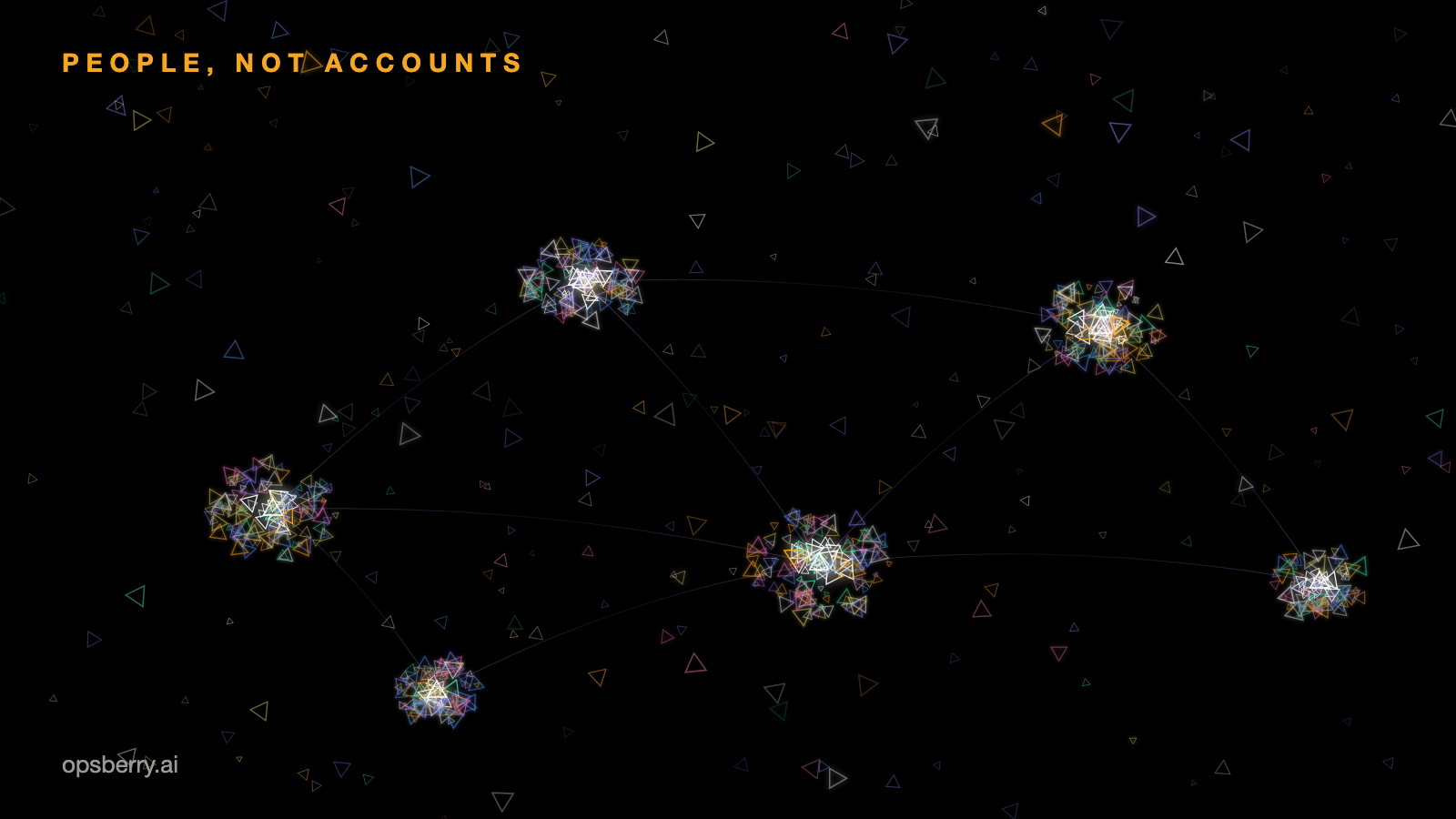
A company-first CRM models the world as companies that happen to contain people. A venture firm experiences the world as people who happen to pass through companies.
When the data model and reality disagree, reality wins, and the database loses. Quietly, one stale record at a time.
People move faster than your database
The numbers on this are worse than most firms assume. Roughly 30% of professionals change jobs every year, invalidating their contact details across every database that holds them. A study tracking 1,000 business contacts found that 70.8% experienced at least one change within 12 months: a new title, a new company, a new email. Job titles alone decay at 25 to 35% per year.
In sales, that decay costs you bounced emails. In venture, it costs you the asset itself. A venture firm's sourcing engine is its network. If a third of the people in that network shift roles every year and the system records none of it, then the firm's map of its own relationships is mostly fiction within three years. Salesforce's own research puts the aggregate damage plainly: 91% of CRM data is incomplete, stale, or duplicated.
Here's the part that stings. The person-first firms don't experience job changes as data rot. They experience them as signal. A founder you liked joining a new company is deal flow. An operator you trust landing at a portfolio company is a win for the portfolio. A company-first model can't even represent the event. A person-first model treats it as the most interesting thing that happened all week.
Three ways company-first breaks a venture firm
The ops lead we spoke with walked us through her daily reality, and her pain points map cleanly to three structural failures.
1. Silent decay
When a contact leaves a company, nothing in a company-first system changes. The record still renders. The title still displays. The relationship looks healthy right up until the email bounces, usually at the worst possible moment: mid-raise, mid-diligence, or the morning a partner lands in New York with a meeting list built on last year's org charts. The system has no concept of "this person probably moved," because the person was never the primary object being tracked.
2. The many-to-many problem
Venture people are gloriously non-exclusive. One human can simultaneously be a founder of one company, an advisor to two others, an angel in a company sitting in your pipeline, and a prospective LP in your next fund. A company-first schema forces a choice: pick one affiliation, or create duplicate contacts under each account. Both options are wrong. The duplicates fragment interaction history; the single affiliation erases the exact web of connections that makes this person valuable to know.
3. Per-partner silos
When relationships attach to accounts and accounts attach to owners, each partner ends up with a private slice of the firm's network. Nobody can see the whole graph. The whole point of a firm-level network, as Carta's writeup on relationship intelligence notes, is analyzing the firm's collective communication history to find who actually holds the warmest path to a target. If the answer lives in one partner's inbox and nowhere else, the firm doesn't own that relationship. The partner does. Partners leave too.
What person-first actually means
Person-first is not a philosophy or a UI preference. It's a schema decision, and you can check for it concretely.
People and organizations are both first-class entities, decoupled and connected. A person is not a row inside an account. A person is a node, an organization is a node, and the affiliation between them is an edge with its own data: role, start date, end date. Employment becomes an event in a history, not a field that gets silently overwritten.
Interaction history attaches to the person and travels with them. The diligence notes, the dinners, the passed deal, the favor owed: all of it should follow the human across every company they touch. When your 2021 founder resurfaces as a 2026 GP, the system should hand you five years of context, not a blank record with a familiar name.
Relationships are data, not vibes. Strength and recency should be computed from actual communication, the emails and meetings that already happened, rather than depending on whichever partner remembers to log a call. Manually maintained relationship data decays at exactly the rate of human discipline, which is to say fast.
Job changes are events the system surfaces, not errors it hides. The moment a contact's affiliation goes stale should generate a flag, because in venture that moment is precisely when the relationship is most actionable.
This matters more right now than it did five years ago. Wellington Management's venture outlook describes a 2026 landscape defined by selectivity and access, which is a polite way of saying the best deals go to whoever holds the warmest path. A firm whose relationship graph is accurate has a compounding advantage over a firm whose graph is 30% fiction and rotting.
Five questions to ask any CRM
If you're evaluating tools, skip the feature grid and ask about the model. These five questions will tell you which side of the divide a product actually sits on:
- When a contact changes companies, what happens to our interaction history with them?
- Can one person hold multiple simultaneous affiliations, with dates, without duplicate records?
- Is relationship strength computed from real communication, or typed in by hand?
- Can everyone at the firm see the full relationship, or only the partner who "owns" it?
- Does the system flag likely job changes proactively, or do we find out from a bounce?
Any vendor can demo a pipeline view. Very few can answer question one without flinching.
We wrote before about why firms keep rebuilding what they already know in The Context Layer, and this is the same argument at the schema level: a venture firm's memory is worth exactly as much as the model it's stored in. Store a people business in a company-first database and you are choosing, up front, to forget the thing you know best.
Your network is people. Your database should be too.
Get a demo and we'll walk you through the fund workflow end to end.
About Opsberry
Opsberry is the AI-powered VC operating system: one AI brain that handles diligence, investor relations, and portfolio management the way your fund works. Built inside CherryRock Capital by Enfra Inc., and backed by Y Combinator.